

Why Georgian Jewelers Put Foil Behind Their Gemstones
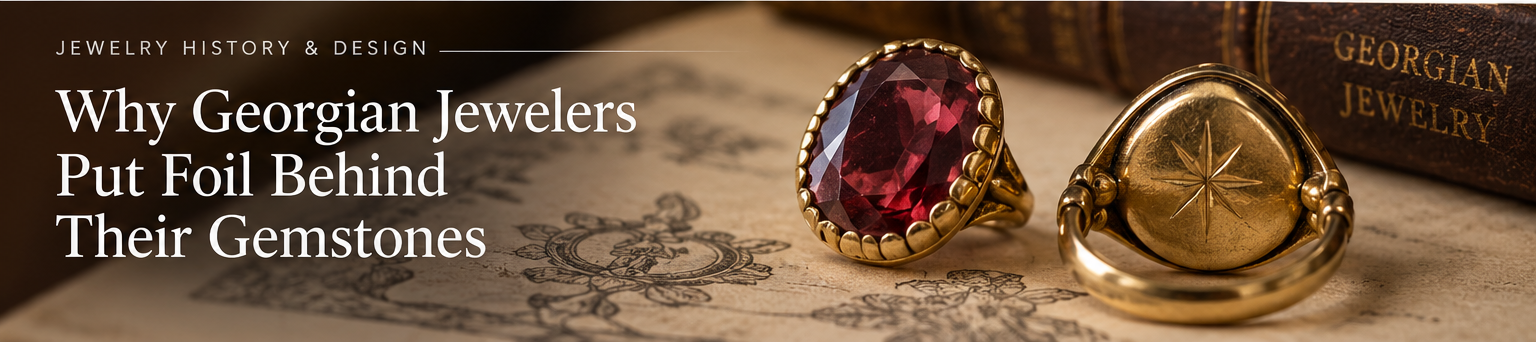
Turn over a modern gemstone ring and chances are you'll see light. Open backs, pierced galleries, prongs, baskets, and carefully engineered settings allow light to move around the stone.
Turn over many pieces of Georgian jewelry and you may find something completely different. The gemstone disappears into metal.
The back is closed. And hidden behind the stone may be one of the cleverest visual tools available to an eighteenth- or early nineteenth-century jeweler: foil.
Jewelry Was Designed for a Different Kind of Light
It is easy to forget that jewelry has always been designed inside an environment.
Georgian jewelers weren't creating pieces to be photographed under LED lights, examined beneath modern jewelry-store spotlights, or worn through offices illuminated by fluorescent fixtures. Their jewelry existed in candlelight, firelight, and the softer illumination available before widespread gas and electric lighting.
That mattered.
The way a gemstone appeared depended not only on the stone and its cut, but also on how the jeweler managed the limited light available. One solution was foil backing.
A thin reflective—or sometimes colored—material could be positioned behind a gemstone to reflect light back through it, increasing apparent brilliance or intensifying its color. Because that foil needed protection, these stones were commonly placed in closed-back settings. Foiled, closed settings consequently became one of the recognizable characteristics associated with Georgian jewelry.
The Setting Was Part of the Optical System
This is something I find particularly interesting as a metalsmith. We often talk about the gemstone as though its visual effect belongs entirely to the stone. But the setting participates. It always has.
The metal surrounding a stone affects how we perceive its size. The bezel thickness changes its visual weight. The height changes its relationship to the hand or body. The color of the metal influences the color we perceive nearby.
And historically, what happened behind the stone could dramatically change what happened in front of it. Foil could brighten a pale or dark stone, reflect available light, or alter the apparent color seen through the gem.
The jeweler wasn't simply holding a gemstone securely. The jeweler was controlling the viewer's experience of it.
Closed Backs Changed the Object Too
A closed-back setting doesn't merely change the optics.
It changes the jewelry as an object. Turn the piece over and instead of seeing the pavilion of the stone, you encounter metalwork. That creates another surface to design.
Historic jewelry can reward us for looking at the back because construction often tells us things the front does not.
How was the setting assembled?
Where are the seams?
How was the stone enclosed?
How was the back finished?
What evidence of the maker's hand remains?
For metalsmiths, the reverse can sometimes be more educational than the front. It exposes decisions.
History Can Change How We Judge Craftsmanship
From a contemporary perspective, it would be easy to look at an old closed-back setting and think:
Why didn't they open the back so more light could enter?
But that question assumes our current solution is automatically the correct one. The historic maker was solving a different problem.
Different gemstone cuts.
Different available light.
Different materials.
Different expectations.
Different tools.
Different fashion.
This is precisely why studying jewelry history can make us better makers. It forces us to distinguish between:
This is how we usually do it now
and
This is the only sensible way it can be done.
Those are not the same thing.
Good Design Responds to Context
There is a lesson here that reaches well beyond antique jewelry. Every design exists within conditions.
Who will wear it?
How will it be worn?
What material is available?
How much weight can the piece carry?
How much maintenance is reasonable?
How will the surface age?
What lighting will the object usually be seen in?
What does the stone need?
What does the wearer need?
Historic jewelers made decisions in response to the world around them. We do exactly the same thing today, even if the variables have changed.
The Invisible Decisions May Matter Most
When we look at a finished piece of jewelry, the most obvious features get our attention.
The stone.
The silhouette.
The color.
The decoration.
But some of the most interesting design decisions are invisible until we start asking how the piece works.
Why this setting?
Why this backing?
Why this proportion?
Why this material?
Why this construction method?
The foil hidden behind a Georgian gemstone reminds us that jewelry has always contained solutions the wearer may never consciously see. And I think there is something wonderful about that.
A well-made object carries the maker's thinking inside it. Sometimes literally.
Look at Historic Jewelry Like a Metalsmith
The next time you see an old piece of jewelry—whether in a museum, book, auction listing, or collection— don't stop at the front. Turn it over if you can. Look closely.
Ask yourself:
How was this made?
What problem was the jeweler solving?
Why might this solution have made sense at the time?
Those questions transform jewelry history from a collection of styles and dates into something much more
useful. It becomes a conversation between makers. One of them may have worked two hundred years before you. But when you begin studying the decisions hidden inside the object, you may discover that the questions they were trying to answer aren't so different from the ones waiting on your own bench today.