

Troubleshooting Is a Skill—and You Can Practice It
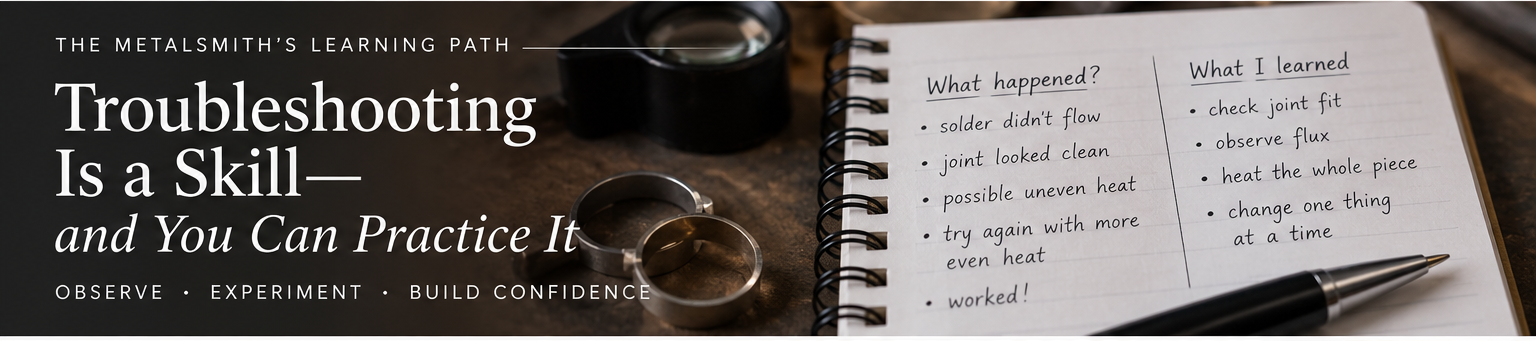
When we talk about learning metalsmithing, we usually talk about techniques.
Sawing.
Soldering.
Forming.
Stone setting.
Finishing.
Those skills are easy to recognize because we can demonstrate them. But there is another skill developing quietly underneath all of them. It may be one of the most important skills you ever learn at the bench.
Troubleshooting.
Beginners Ask "What Do I Do?"
When you're learning something for the first time, you need steps. That's perfectly reasonable.
Cut here.
File this edge.
Anneal now.
Place the solder here.
Move the flame this way.
Experienced instruction helps you avoid unnecessary mistakes while you build familiarity with the tools and materials. But eventually something happens that isn't in the demonstration.
Your metal moves differently.
Your joint doesn't fit.
Your stone rocks.
Your solder refuses to flow.
Your bezel stretches.
Your dimensions don't match.
Now the instructions aren't enough. And that moment—frustrating as it may feel—is often where the most valuable learning begins.
Experienced Metalsmiths Ask "Why Did That Happen?"
Experience doesn't mean nothing goes wrong. It changes the questions you ask when something does. Instead of immediately looking for another tutorial, you begin observing the situation.
What changed?
Where did the problem begin?
What happened immediately before I noticed it?
Which variables could have caused this?
What evidence can I see in the metal?
That shift from following instructions to interpreting results is a major milestone in becoming an independent maker.
Troubleshooting Requires Observation
You can't diagnose something you haven't really looked at. Consider a stone that rocks in its setting. "Why is my stone loose?" gives us very little information. But then we look closer.
Does it rock side to side?
Front to back?
Is the girdle sitting evenly?
Is one section of the seat deeper?
12Does the stone rotate?
Is the bezel distorted?
Is the opening symmetrical?
Each observation narrows the possibilities. Soldering works the same way. So does forming. So does fabrication.
The more specifically you can describe what happened, the closer you get to understanding why.
Build a Mental Library of Cause and Effect
This is one reason practice samples matter. A practice sample doesn't have to become jewelry to be useful. Sometimes the most valuable experiment is one designed simply to answer a question.
What happens if the joint has a small gap?
What does overheated flux look like?
How does a bur behave when I change the angle?
How much does this dimension change after forming?
What does an undercut seat look like compared with a properly cut one?
When you intentionally observe those differences, you begin building a mental library. Later, when something similar happens in a real project, you recognize it. You've seen that clue before.
Don't Correct the Problem Too Quickly
This sounds strange, but when something goes wrong, spend a moment looking at it before you fix it. We are often so eager to rescue the piece that we erase the evidence. Before correcting the problem, ask:
What am I seeing?
Take a photograph if necessary. Look under magnification. Check dimensions. Notice where solder flowed. Notice where the metal distorted. Notice where a tool mark begins and ends. Then make the correction.
Over time, those observations become remarkably valuable.
Change One Thing
Good troubleshooting is an experiment. If five things might be causing a problem and you change all five at once, you may solve it—but you haven't necessarily learned much.
When possible, change one variable. Try again. Observe the result.
Did the problem improve?
Disappear?
Stay exactly the same?
That result gives you information. This is the same kind of reasoning makers develop almost unconsciously after years at the bench. The good news is that you don't have to wait years to start practicing it intentionally.
Keep Bench Notes
You don't need an elaborate journal. A few simple notes are enough:
What was I trying to do?
What happened?
What did I think caused it?
What did I change?
What happened next?
That record becomes surprisingly powerful. You'll begin noticing patterns. Maybe most of your soldering problems occur on assemblies with uneven mass. Maybe your stone-setting problems appear when you rush the layout. Maybe your bezels distort during one particular part of the process.
Patterns are difficult to see when every problem feels like an isolated incident. Notes connect them.
The Goal Isn't a Perfect Bench Session
One of the traps in learning a craft is believing that progress should eventually eliminate mistakes. It doesn't. What changes is your relationship with them.
A bench problem becomes less likely to stop the entire project because you have a process for investigating it.
Observe.
Evaluate.
Form a hypothesis.
Change something deliberately.
Look at the result.
Repeat if necessary.
That is troubleshooting. And just like sawing, soldering, forming, or setting stones, it improves with practice.
This Is How Independence Develops
There will always be another book, video, class, instructor, or mentor who can help us learn. I hope there will be.
I still learn constantly. But the ultimate goal of good instruction isn't to make you dependent on instructions. It's to help you become increasingly capable of standing at your own bench, looking carefully at the problem in front of you, and thinking:
I may not know the answer yet—but I know how to start figuring it out.
That is a skill worth practicing.