

Why Ancient Jewelry Still Feels Modern
One of the things I love most about studying jewelry history is how often I see something made hundreds—or even thousands—of years ago and think:
I would wear that now.
Not because it looks antique. Not because I am trying to recreate a historical style. But because the design itself still works.
A beautifully balanced Roman ring, an Etruscan granulated pendant, an Egyptian collar, a Viking brooch, or a Byzantine gold earring can still feel surprisingly contemporary when you strip away the dates and museum labels.
That tells us something important as designers. Good jewelry design is not always about being new.
Sometimes it is about understanding what has worked for a very long time.
Ancient Jewelers Were Solving the Same Problems We Are
The tools have changed. The materials available to us have expanded. Our torches, flex shafts, microscopes, casting equipment, and digital design tools would look like magic to many early metalsmiths. But the fundamental design problems have not changed very much.
A jeweler still has to consider:
How does this piece sit on the body?
How much visual weight can it carry?
Where does the eye travel first?
Does the form feel balanced?
Is the structure strong enough?
How does the material affect the design?
What does this object communicate about the person wearing it?
Those questions are ancient. That is part of the reason historical jewelry can still feel so relevant. The makers were solving problems that we continue to solve at the bench today.
Simple Geometry Ages Well
Look carefully at jewelry from many ancient cultures and you will see circles, spirals, crescents, rectangles, repeated dots, braided forms, and strong symmetrical arrangements.
There is a reason those shapes appear again and again. They are visually powerful. A circle does not depend on a trend. Neither does a strong line, a repeated pattern, or a carefully proportioned form.
That does not mean ancient jewelry was simple. Some pieces were extraordinarily complex. But even in highly decorated work, the underlying structure was often very clear. This is something worth paying attention to as a contemporary designer.
Decoration can change dramatically over time. Strong proportion tends to survive it.
Repetition Creates Rhythm
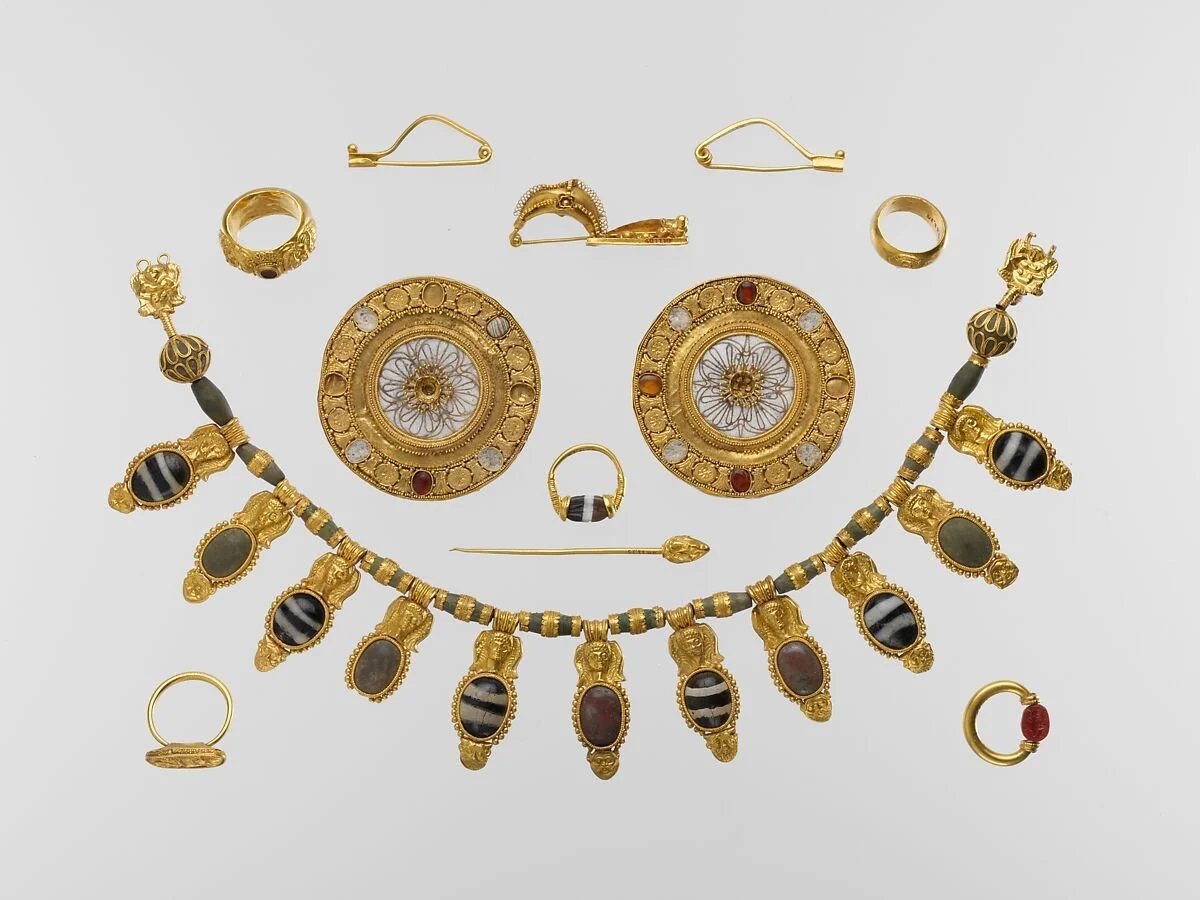
Set of Jewelry, Etruscan, Late Archaic period. Gold, glass, rock crystal, agate, and carnelian. The Metropolitan Museum of Art. Public Domain.
One of the most useful things history can teach a jewelry designer is how powerful repetition can be. Ancient makers used rows of beads, granules, wire, stamped marks, linked elements, and repeating motifs to create rhythm. You see it in Etruscan granulation. You see it in Egyptian beadwork. You see it in chains, borders, collars, fibulae, and decorative metalwork across cultures.
Repetition does something interesting to a piece. It makes the eye move. One element becomes a pattern. A pattern becomes rhythm. Rhythm creates energy.
You do not have to reproduce historical ornament to learn from it.
You can simply ask:
What happens if I repeat this form?
Three stones instead of one.
A series of pierced openings.
Repeated rivets.
A pattern of raised forms.
A line of small forged marks.
That is where studying history becomes useful rather than academic. You begin seeing design strategies you can adapt instead of styles you need to copy.
Ancient Jewelry Was Designed for the Body
Jewelry is not sculpture sitting on a pedestal. It has a wearer. That may sound obvious, but it is easy to forget when we become absorbed in making an object.
Historical jewelry reminds us constantly that jewelry was designed to move with the body.
Brooches held garments together.
Pins secured fabric.
Bracelets wrapped the wrist.
Torcs encircled the neck.
Earrings moved beside the face.
Rings emphasized the hand.
Jewelry was decorative, symbolic, functional, social, and personal all at once. When you study an ancient piece, do not only look at the object.
Imagine it being worn.
How would it move?
Where would the light hit it?
How would its scale relate to the body?
Would it feel delicate, commanding, protective, ceremonial, intimate?
That perspective can completely change the way you look at design.
Material Was Part of the Message
Gold has never simply been yellow metal. Silver has never simply been gray metal. Gemstones have never simply been color. Materials carry meaning.
Historically, jewelry communicated wealth, power, protection, faith, rank, identity, belonging, mourning, marriage, and status.
A material might be rare. It might have traveled hundreds of miles through trade. It might carry religious significance. It might be associated with royalty or protection.
The maker was not choosing materials only because they looked good. The materials were part of the story. That is still true. Even when we are not designing ceremonial or status jewelry, materials affect how a piece is understood.
A heavy oxidized silver object feels different from a delicate high-polish gold one. A rough mineral surface tells a different story than a precision-cut diamond. A found object creates a different emotional response than a flawless gemstone.
Jewelry history teaches us to think beyond:
What material looks good here?
And toward:
What does this material contribute to the meaning of the piece?
Handmade Irregularity Is Not the Same as Poor Craftsmanship
This is another reason I think historical jewelry is so valuable for metalsmiths to study. Look closely at truly old work. It is often not perfectly identical. Granules may vary slightly. Hammer marks may remain. Wire may not be mathematically uniform. Repeated elements may carry small variations. And yet the piece can still feel incredibly refined. That distinction matters.
Handmade work does not need to look machine-made to demonstrate craftsmanship. Craftsmanship is not always the elimination of every sign of the hand.
It is control.
It is intention.
There is a difference between an irregularity that happens because the maker lacked control and one that remains because the process itself is visible.
Historical jewelry can help train your eye to see that difference.
Design Ideas Travel Across Time and Culture
The more jewelry history you study, the harder it becomes to believe that design develops in a straight line. Forms disappear and return. Techniques are rediscovered. Motifs move through trade routes. One culture influences another. Older styles are revived hundreds of years later and interpreted differently.
The nineteenth century alone is full of designers looking backward toward Egyptian, Etruscan, Gothic, Renaissance, and classical sources. And contemporary jewelry continues doing exactly the same thing.
Design is a conversation. Sometimes we are responding to another contemporary maker. Sometimes we are responding to Art Nouveau. Sometimes we are responding to an object made two thousand years ago by someone whose name was never recorded.
That does not make a design less original. Originality is rarely the absence of influence. It is what you do with the influences you absorb.
Study the Structure, Not Just the Style
This may be the most important lesson.
When you find a historical piece you love, resist the temptation to simply ask:
How could I make something that looks like this?
Instead, ask:
Why does this work?
Look at the proportion.
Look at the negative space.
Look at the repetition.
Look at the way the stone relates to the metal.
Look at the relationship between the focal point and the supporting elements.
Look at where the maker added detail and where they allowed the form to stay quiet.
Look at the structure underneath the decoration.
Then take that principle somewhere new.
You might admire an ancient collar not because you want to make an ancient collar, but because you notice how repeated forms gradually change in scale.
That idea could become a bracelet.
A series of rings.
A brooch.
A completely abstract sculptural piece.
That is how history becomes part of your design language without turning your work into reproduction.
The Past Is an Enormous Design Library
Every time I study historical jewelry, I come away with more questions than answers. That is a good thing. I begin noticing forms.
Connections.
Techniques.
Ways of joining.
Ways of repeating.
Ways of allowing metal to carry meaning.
The history of jewelry is not simply a timeline of objects we are supposed to memorize. It is thousands of years of metalsmiths experimenting with the same materials, forms, technical problems, and human desire to adorn the body that we are still exploring today. Those makers may be separated from us by centuries. But when you look closely at the work, the distance begins to disappear.
You recognize the decisions.
You recognize the problem solving.
You recognize the hand.
And sometimes you recognize an idea that feels so current that you could imagine it coming off a contemporary bench tomorrow.
That is why jewelry history matters to designers. The past is not finished. It is still sitting there, waiting for us to look more closely.