

Sapphire: Designing and Setting Beyond “It’s a 9 on the Mohs Scale”
Sapphire is often summarized with one reassuring fact:
Mohs hardness: 9.
That fact matters. But if you are the person designing and setting the jewelry, it is nowhere near enough information. A jeweler needs to understand not only whether a gemstone will scratch.
We need to understand:
What the stone is made of.
How it breaks.
How it was cut.
Whether its color changes with orientation.
Whether the stone contains vulnerable inclusions.
Whether it has been treated.
How high it should sit.
How much metal should protect it.
And what choices the gemstone itself has already made for the design before we ever touch the metal. That is where this new Colored Gemstones series begins.
What Sapphire Actually Is
Sapphire belongs to the mineral species corundum. Chemically, corundum is aluminum oxide: Al₂O₃. Ruby is also corundum. The name sapphire is generally used for gem-quality corundum in colors other than ruby red.
Sapphire can occur in blue, yellow, pink, purple, green, orange, colorless, and other hues. GIA lists corundum at 9 on the Mohs hardness scale with a refractive index of approximately 1.762–1.770.
That hardness gives sapphire excellent resistance to scratching compared with most colored gemstones. But hardness is only one part of durability.
Hardness Is Not the Same Thing as Toughness
This distinction matters at the bench.
Hardness describes resistance to scratching and abrasion.
Toughness describes resistance to breaking and chipping.
Stability describes how a gemstone responds to conditions such as heat, chemicals, and light.
These are separate properties. Sapphire performs very well overall. Corundum has no cleavage and GIA classifies sapphire as having excellent toughness, making it a strong candidate for rings and other jewelry exposed to frequent wear.
But “excellent toughness” does not mean “cannot be damaged.”
A thin girdle can chip.
An exposed point can break.
A fracture reaching the surface can create risk.
A poorly supported stone can still fail under pressure.
The setter must evaluate the actual stone, not only the mineral species.
Look at the Girdle Before You Design the Setting
Before deciding on prongs, bezel thickness, halo dimensions, or overall height, inspect the girdle.
Is it even?
Very thin?
Extremely thick?
Faceted?
Polished?
Does one area contain an inclusion?
Does a fracture approach the edge?
Does the outline remain symmetrical?
This information should influence the setting. A stone with a vulnerable girdle area may benefit from protection. A well-cut sapphire with a strong girdle may allow more openness. The setting should respond to the gemstone you actually have—not the generic sapphire illustrated in a diagram.
Sapphire Cut Is About Color as Much as Brilliance
Diamond cutting discussions often revolve heavily around light return. Colored gemstones introduce another major variable:
color distribution.
Sapphire rough can display color zoning and pleochroism.
GIA notes that cutters orient sapphire to manage color zoning, pleochroism, lightness or darkness, and weight retention. Blue sapphire may show greenish-blue and violetish-blue pleochroism, and cutters generally orient the stone so the more desirable color dominates face-up.
This matters enormously to the jewelry designer. Rotate the stone before designing around it. Look at it:
face-up,
from the side,
against white,
against metal,
in natural light,
and in directional bench light.
The sapphire may look dramatically different depending on orientation.
Why Ovals Are So Common
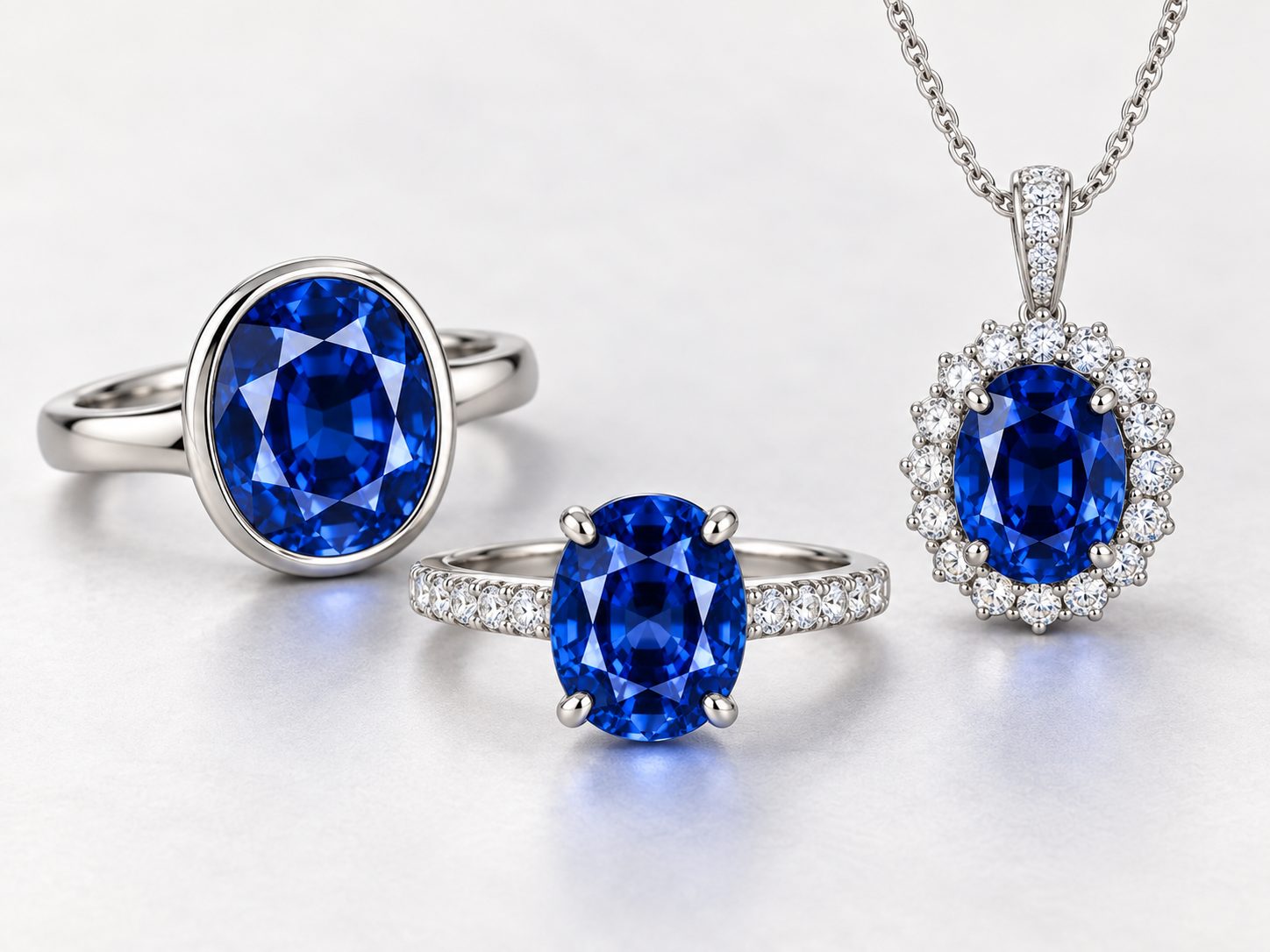
Oval mixed cuts are extremely common in sapphire. GIA describes typical corundum ovals as having triangular and kite-shaped crown facets paired with parallel rectangular pavilion facets.
Why do we see so many? Partly because the shape often works efficiently with sapphire rough. The natural crystal form, color zoning, weight retention, and orientation all influence the cutter’s decisions. That means a sapphire may not have diamond-like proportions.
The pavilion may be deeper.
The belly may be fuller.
The culet may sit off-center relative to what you expected.
This has direct consequences for the setter.
Measure Depth Before You Build
Do not design from length and width alone. Measure the stone’s depth. Then look at the pavilion shape. A deep sapphire can require far more vertical space than its face-up dimensions suggest.
This affects:
basket height,
gallery clearance,
seat location,
finger clearance,
overall ring profile,
and how much metal must exist beneath the stone.
If you design the mounting before considering depth, you may discover that the pavilion collides with the structure you already built.
The gemstone should inform the architecture from the beginning.
Watch Dark Stones Carefully
Some sapphires can appear extremely dark. A heavy bezel or enclosed setting can make a dark sapphire feel even darker visually. That does not mean a bezel is wrong. It means the designer should evaluate what the setting does to the stone’s appearance. Before committing, test the stone against different backgrounds. Ask:
Does it need more visual openness?
Would a narrow bezel be better than a heavy one?
Would yellow metal warm the color?
Would white metal create sharper contrast?
Does the pavilion need visual space around it?
These are design decisions informed by the gemstone.
Prongs or Bezel?
Sapphire’s durability gives designers considerable flexibility. Prongs can expose more of the gemstone and emphasize its outline. A bezel can provide additional protection and create a stronger relationship between stone and metal. Neither is automatically better. The right decision depends on:
how the jewelry will be worn,
the girdle condition,
the stone’s shape,
vulnerable points or corners,
setting height,
design language,
and the individual stone.
Protective settings such as bezels and halos can play an important role in preventing damage to colored gemstones, particularly when the design needs additional edge protection.
Treatments Matter to the Jeweler
Many sapphires have been treated. Heat treatment is widely used. Lattice diffusion may also be used to alter color. Some material may be fracture-filled, cavity-filled, or dyed.
GIA recommends asking about treatment because treatment can affect value as well as cleaning and care requirements. For a jeweler, treatment is not merely paperwork. It can affect what you safely do at the bench.
Untreated and conventionally heat-treated sapphire is generally stable under ordinary conditions, but filled, dyed, or otherwise treated material can require greater caution. Boric acid can also etch the surface of corundum.
Know what you have before exposing the stone to heat or chemicals.
The Designer’s Control Begins Before the Setting
This is perhaps the most important idea in the entire series. Safe gemstone setting does not begin when you pick up the setting tool. It begins when you evaluate the stone. You control:
the setting style,
the amount of protection,
the metal thickness,
the seat location,
the height,
the orientation,
the background color,
the visual openness,
and the relationship between the gemstone and the rest of the piece. Those decisions determine how difficult the eventual setting job becomes.
What Sapphire Teaches Us
Sapphire is forgiving enough to be widely used in everyday jewelry. But it is sophisticated enough to teach us almost everything we need to know about designing around a colored gemstone.
Mineralogy matters.
Cutting matters.
Color matters.
Orientation matters.
Treatments matter.
The girdle matters.
The pavilion matters.
The setting matters.
And none of those decisions exists independently. That is how I want to approach colored gemstones in this series.
Not simply:
What is this stone?
But:
What does knowing this stone require me to do differently as the jeweler?
That is where gemology becomes useful at the bench