

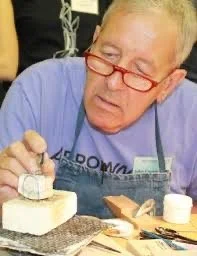
John Cogswell: August 24, 1948 - January 24, 2024
Some makers expand our understanding of jewelry through unexpected materials or dramatic scale. Others remind us how much possibility lives inside a carefully considered construction. John Cogswell belongs in this conversation because his work connects making, explaining, and understanding.
The lesson I want to draw from that connection is practical: craftsmanship gives a design somewhere dependable to stand. When you understand how a setting works, you can make more deliberate choices about how it looks. Precision becomes a resource for your imagination.
A maker who also explains
Cogswell is a jeweler, silversmith, educator, and author and illustrator of Creative Stonesetting. His teaching history includes SUNY New Paltz, Parsons, Pratt, Hofstra, and the 92nd Street Y, where he directed the Jewelry and Metalsmithing Department. Arrowmont also documents his longstanding connection to its teaching community.
Creative Stonesetting addresses custom settings for unusual gems, with more than 600 drawings by Cogswell. Its emphasis reaches beyond fitting a stone into a conventional mounting to considering the tools, procedures, and construction of a setting.
That combination of maker and illustrator interests me. A useful technical drawing makes relationships visible. It shows where support belongs, how parts meet, and what may be hidden beneath the finished surface. Studying those relationships can be more valuable than memorizing the silhouette of a finished piece.
Precision begins before the tool touches metal
It is easy to associate precision with the final stages of a project: the neat seam, the even bezel rim, the smooth finish. But those results depend on decisions made much earlier.
Imagine a stone with an uneven girdle. A setting designed only from its length and width may look convincing on paper yet fail to support it properly. The practical questions are more specific.
Where will the stone bear?
What needs clearance? How much metal must remain after fitting?
Can the setting tool reach the retaining edge?
These are my applications of the process-minded lesson I see in Cogswell's work, rather than a summary of a particular exercise from his book. They ask the hand to act on an understood structure instead of an approximate picture.
Repeatable process creates useful comparisons
A repeatable process does not mean producing identical jewelry. It means knowing enough about your method to recognize what changed.
If you make three practice settings with different stone sizes, different wall thicknesses, and different tools, an improvement may be difficult to explain. Keep the basic construction consistent and change one meaningful variable, and the result becomes easier to read.
For example, practice fitting the same type of inexpensive stone into two similar settings. Record the wall thickness, the support arrangement, and where you removed metal. Compare stability before closing either setting. You are building a record of cause and effect, which makes the next design decision less dependent on hope.
Make the construction part of the design
Technical understanding also helps you recognize when a familiar setting is the wrong answer. Perhaps a standard bezel hides the feature that attracted you to the stone. Perhaps a tall mounting solves pavilion clearance but creates an awkward profile.
Draw alternatives in section as well as from above. A section drawing can reveal a heavy wall, an unsupported edge, or a tool-access problem that a top view conceals. Consider how a change in support affects proportion and how a change in height affects wear.
The goal is a setting whose structure serves the particular stone and the particular piece. That is where fabrication judgment begins to become design judgment.
An observation to take to the bench
Choose one setting in your own work and sketch a section through it. Mark the supporting metal, the retaining metal, and the space required beneath the stone. Then identify one decision you made deliberately and one you made because it was familiar.
You do not need to remake the piece today. Start by making its construction understandable.
Explore more Makers Who Shaped Me articles in the Metalsmith Mentor Journal, and leave a comment: which part of your process becomes clearer when you draw it before making it?