

A tutorial gives you a sequence, a materials list, and a picture of the destination. Then you begin a piece of your own and discover that nearly every step contains a choice.
How wide should the band be?
Where should the join sit?
Would a bezel support the design better than prongs?
Learning to answer these questions is part of becoming an independent metalsmith.
Begin with the intended use
Before drawing details, write a sentence describing what the piece needs to do. For example: I am designing a pendant for frequent wear that sits close to the chest and allows the stone to remain the focal point.
That sentence creates useful boundaries. It helps you judge a projecting element, a heavy backing, or a decorative bail by whether it supports the piece’s purpose. It also gives you a reason to change an attractive idea that creates an avoidable wearing problem.
Include the wearer, expected use, and any important material constraints. A special occasion brooch can invite different decisions from a ring worn while working with the hands.
Give each choice a reason
Divide the design into decisions you can examine. Start with proportion, material, construction, setting, and finish. For each, write your present choice and the reason behind it.
A broad border may give a small stone more visual presence. A narrower border may keep attention on its color. Either can work, but the reason should connect to the design. If the explanation is simply that you saw it in another project, make another sketch and compare the alternatives.
Material choices also affect what can be fabricated successfully. Sheet thickness, alloy, stone condition, and the demands of a joint influence the construction. A drawing can suggest a solution, but a test sample may be needed to show whether your tools and skills can produce it.
Separate visual questions from technical questions
When a piece feels wrong, name the uncertainty before changing it. A pendant that looks too heavy may have a proportion problem. One that tilts forward may have a suspension problem. Adding texture will not necessarily solve either.
Make two versions of the same sketch with one visible difference. Change the border width while keeping the stone and bail consistent. Then use a paper or inexpensive material model to investigate scale on the body. If the unresolved question is technical, such as how a seam will fit or whether a component can be formed, make a focused construction sample.
Different questions need different evidence. A successful solder sample does not prove the composition is balanced, and a beautiful drawing does not prove the stone can be set safely.
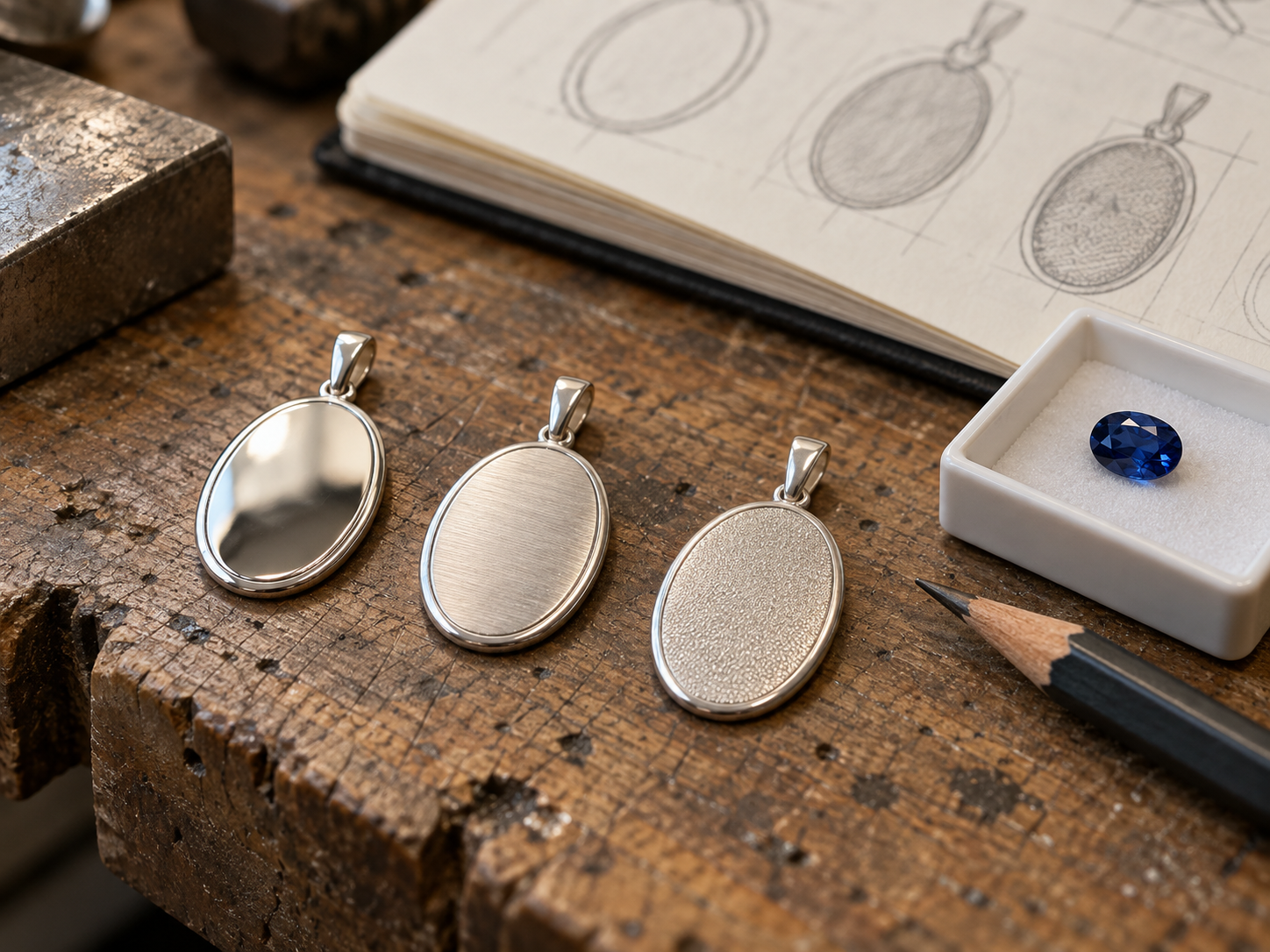
Practice making a small decision independently
Choose a technique you already understand and give yourself a limited assignment. Keep the basic construction familiar, but decide the proportion or finish yourself. This keeps the number of unknowns manageable.
Before making the piece, record what you expect the change to accomplish. Afterward, photograph it at normal viewing distance and on the body if appropriate. Compare the result with your expectation.
Did the stone become more prominent?
Did the finish reveal the form?
Did the bail support the pendant where you intended?
Write one next change based on what you observed. A specific note such as shorten the bail to reduce forward tipping is more useful than I do not like it. It gives you something you can test.
Use references to ask better questions
Studying another maker’s work can help you notice a relationship between elements. Ask how the construction supports the form, where repetition creates rhythm, or how surface changes the apparent volume. Bring the question into your own work without reproducing the maker’s solution.
My Bench can support the practice and recordkeeping behind these decisions. If you want help examining the design itself, explore Metalsmith Design Mentor through the Choose Your Mentor page.
Which decision do you find yourself postponing until fabrication has already begun? Share it in the comments, and describe what evidence might help you decide earlier.