

When Making Became Part of the Message
By the late nineteenth century, industrial production had changed what objects looked like, how quickly they could be produced, who could afford them, and how the people making them experienced their work. The Arts and Crafts movement grew partly from a deep unease with that transformation.
Its advocates were not simply nostalgic for old-fashioned tools. They were asking a much larger question: what do we lose when making becomes separated from design, material, and the person doing the work?
Jewelry became one of the most interesting places to explore that question because jewelry had long been associated with preciousness, status, symmetry, and technical polish. Arts and Crafts jewelers began shifting the emphasis away from material value alone and toward design, workmanship, and the character of the handmade object.
A Reaction to Industrial Uniformity
The Victoria and Albert Museum describes the broader Arts and Crafts movement as a late nineteenth-century response to industrialization and to the low status often assigned to the decorative arts. Rather than operating as one rigid visual style, the movement was connected by principles: respect for materials, meaningful work, thoughtful design, and the reintegration of the person who designed an object with the process of making it.
In jewelry, that often meant rejecting the visual language of machine-led repetition. Instead of trying to make handwork disappear, makers allowed it to remain visible.
This did not mean careless workmanship. Quite the opposite. The goal was not roughness for its own sake. The goal was for the construction, material, and touch of the maker to belong to the design.
The Gemstone Did Not Have to Be the Most Expensive Thing in the Piece
One of the most radical shifts was the treatment of gemstones. Arts and Crafts jewelers often favored cabochons, opals, moonstones, garnets, turquoise, pearls, enamel, and other materials whose beauty did not depend on the diamond-centered hierarchy of conventional fine jewelry.
The V&A notes that many Arts and Crafts jewelers preferred domed cabochons to large faceted stones. That choice changed more than the surface appearance. A cabochon invites a different setting vocabulary. It emphasizes color, glow, pattern, and body rather than brilliance alone.
For a metalsmith, this is a useful design lesson. Material value and design value are not the same thing. A stone does not have to be expensive to deserve a thoughtful setting, and precious metal does not automatically make a design strong.
Enamel, Wirework, Texture, and Visible Construction
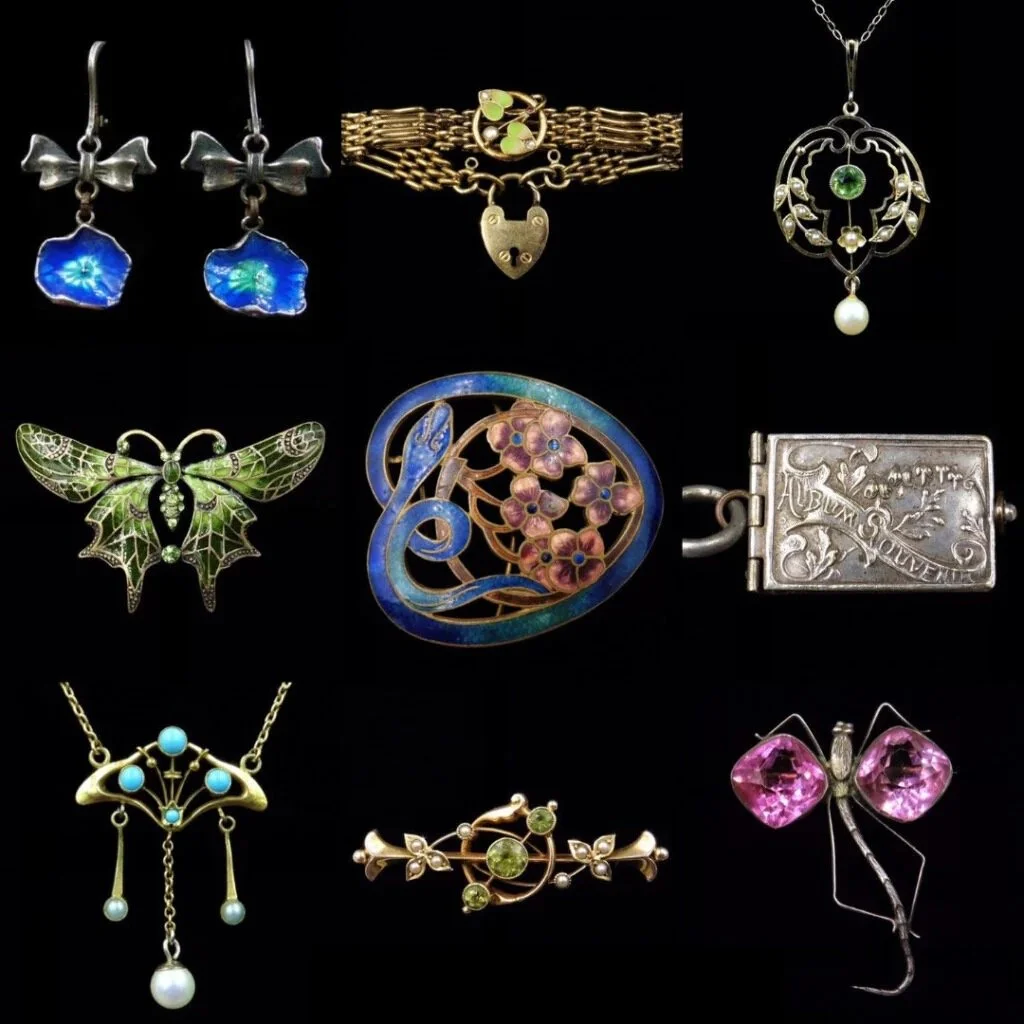
Arts and Crafts jewelry often celebrates techniques that visibly record the act of making: enamel, wirework, pierced metal, hammered surfaces, irregular pearls, hand-formed leaves, and settings that feel constructed rather than mechanically stamped.
Look closely at work by makers such as Arthur and Georgie Gaskin and you can see how these elements work together. The metal is not merely a frame holding gemstones. It creates rhythm, structure, botanical movement, and areas of color. The piece feels assembled by a person making decisions at every stage.
That is very different from ornament added after the structure has already been solved.
“Honest Materials” Does Not Mean Simple Materials
The phrase “honest materials” can sound like an instruction to use only plain or humble substances. I think the more useful interpretation is to allow a material to behave like itself.
Silver can tarnish and develop depth. Hammered metal can show the rhythm of the tool. Enamel can be luminous rather than pretending to be a gemstone. A cabochon can be valued for color and internal character instead of being forced into the visual expectations of a brilliant-cut diamond.
In that sense, material honesty is closely related to design honesty. The maker stops asking the material to disguise itself.
The Contradiction Is Part of the History
There is an important tension in the Arts and Crafts story. Many of its makers wanted well-designed handmade objects to improve everyday life, yet truly handmade work was labor-intensive and often expensive. The V&A notes that despite the ideal of bringing beauty to ordinary people, many Arts and Crafts objects were affordable mainly to wealthier buyers, while companies later adapted aspects of the style for mass production.
That contradiction is worth remembering because we still live with it as contemporary makers. We value handwork, but handwork takes time. We want work to be accessible, but we also need to price labor sustainably. We admire the uniqueness of handmade objects while working in a culture accustomed to inexpensive manufactured goods.
Those are not new problems.
What This Movement Can Still Teach a Metalsmith
The Arts and Crafts movement is not useful because we need to reproduce its floral motifs or medieval references. It is useful because its questions are still alive at the bench.
Does the design respect the material? Can the viewer understand something about how the object was made? Are we adding detail because it belongs, or because we feel an empty surface must be filled? Does the value of the piece come only from the price of its materials, or from the quality of thought and workmanship inside it?
Most of all: where is the maker in the finished object?
The hand does not have to announce itself loudly. Sometimes it appears in a subtle hammer mark, a carefully fitted irregular stone, a carved line, or the slight variation that tells us this object was resolved one decision at a time.
That visible presence of decision-making may be one of the most enduring gifts Arts and Crafts jewelry gave to studio metalsmithing.