

The Makers Who Shaped Me: Charles Lewton-Brain and the Art of Thinking Like a Metalsmith
There are moments in a creative career that quietly become milestones.
Not because you won an award.
Not because you sold a piece.
But because you suddenly find yourself standing face-to-face with someone whose ideas helped shape the artist you've become.
For me, that moment happened at the SNAG Conference runway show.
Standing there, wearing my MFA thesis work, I found myself talking with Charles Lewton-Brain.
To anyone outside the metalsmithing world, he was simply another attendee.
To me?
He was one of my heroes.
Before We Ever Met
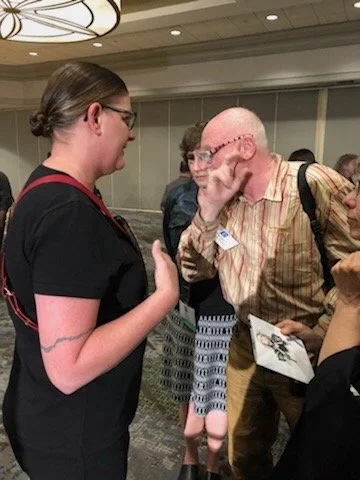
Discussing my “Heart Armor” at the SNAG EIM 2028.
Long before I ever had the opportunity to shake his hand, I had been studying the way Charles approached making.
Most jewelers know him as the creator of Foldforming, a process that forever changed how artists think about moving sheet metal. His discoveries proved that simple folds, strategic hammer blows, and an understanding of metal could produce forms that looked impossibly complex.
But what fascinated me wasn't just the technique.
It was his willingness to experiment.
Every discovery began with a question.
"What happens if…"
That mindset became contagious.
Learning to Experiment
Like many metalsmiths, I started by trying to understand the mechanics.
I made paper templates.
I translated those templates into copper.
Then I watched the metal transform.
The first samples were exercises.
The second became observations.
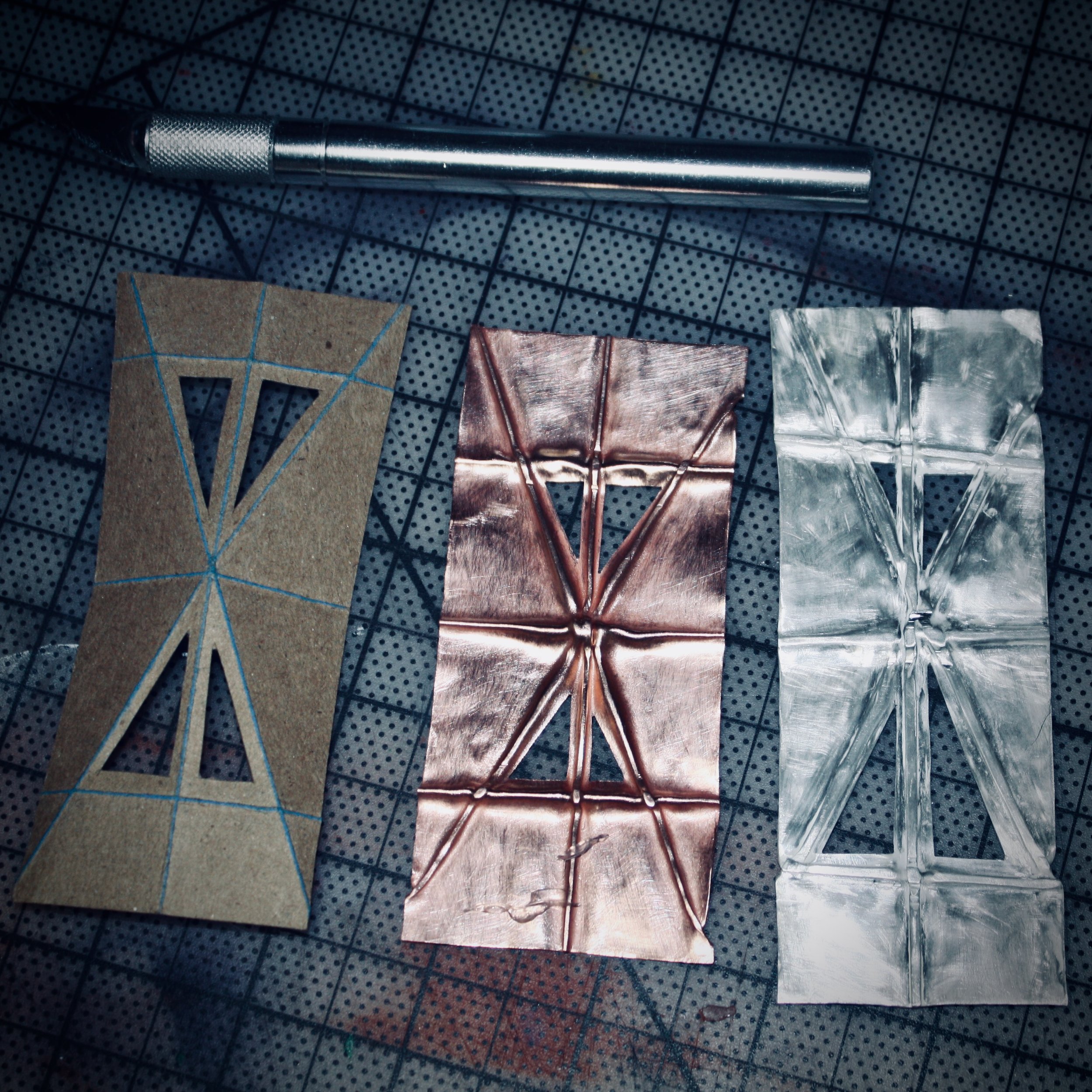
Foldforming samples from my thesis work in 2017.
Eventually they became ideas.
Looking back now, I realize I wasn't really learning Foldforming anymore.
I was learning how to think experimentally.
The photographs from that time still make me smile. Paper patterns sitting beside folded copper. Tiny discoveries scattered across my workbench. Each one asking another question instead of trying to reach a finished piece.
That may be Charles' greatest gift as an educator.
He teaches curiosity.
When Technique Becomes Your Own Voice
As my graduate work developed, those experiments began showing up somewhere completely unexpected.
My thesis.
The anatomical forms in my work—the heart, lungs, and organic structures—weren't literal examples of Foldforming.
They were informed by it.
The stretched surfaces.
The flowing ridges.
The organic tension held inside sheet metal.
Those ideas had become part of my own vocabulary.
That's one of the beautiful things about great teachers.
If they're successful, you eventually stop trying to make work like theirs.
Instead, you begin making work that wouldn't exist without them.
The Conversation I'll Never Forget
Then came the SNAG runway show.
There I was, wearing my thesis armor.
A piece that represented years of research, countless failures, endless fabrication, and more than a few late nights wondering if I'd ever finish.
And Charles Lewton-Brain stopped to look.
Not just glance.
Really look.
Then we talked.
To this day, it's difficult to describe what that felt like.
Imagine spending years learning from someone's books, articles, and ideas...
...and then finding yourself discussing your own work with them.
Not as a student in a classroom.
But as another artist sharing ideas.
I don't remember every word we exchanged.
What I remember is how generous he was with his attention.
He wasn't evaluating me.
He was genuinely curious.
That's exactly the person his writing always suggested he would be.
More Than Foldforming
Charles influenced far more than my thesis.
He influenced the way I teach.
If you've spent any time watching my videos or reading my articles, you've probably noticed something.
I don't just show how to do something.
I spend far more time explaining why.
Why the metal moves.
Why the solder behaved that way.
Why the stone won't seat correctly.
Why your bezel distorted.
Because once you understand the reason behind a process, you stop memorizing steps.
You start making decisions.
That philosophy is woven through everything I create for Metalsmith Mentor.
The worksheets.
The troubleshooting guides.
The downloadable references.
The calculators.
The AI coaching I'm building.
The goal has never been to give students answers.
It's to help them learn how to think through the problem themselves.
I didn't invent that philosophy.
I learned it from remarkable educators like Charles Lewton-Brain.
Looking Back
Bruce Metcalf taught me that jewelry could communicate ideas.
Charles Lewton-Brain taught me that experimentation could become a language.
One shaped my artistic voice.
The other shaped my curiosity.
Today, when I sit at my own bench designing resources for future metalsmiths, I often think about teachers like Charles.
Knowledge doesn't disappear when it's shared.
It multiplies.
And perhaps that's the greatest lesson he ever taught me.
Not through Foldforming.
Not through books.
Not through workshops.
But by demonstrating that the real legacy of a metalsmith isn't simply the objects they make.
It's the generations of makers they inspire to ask one more question.