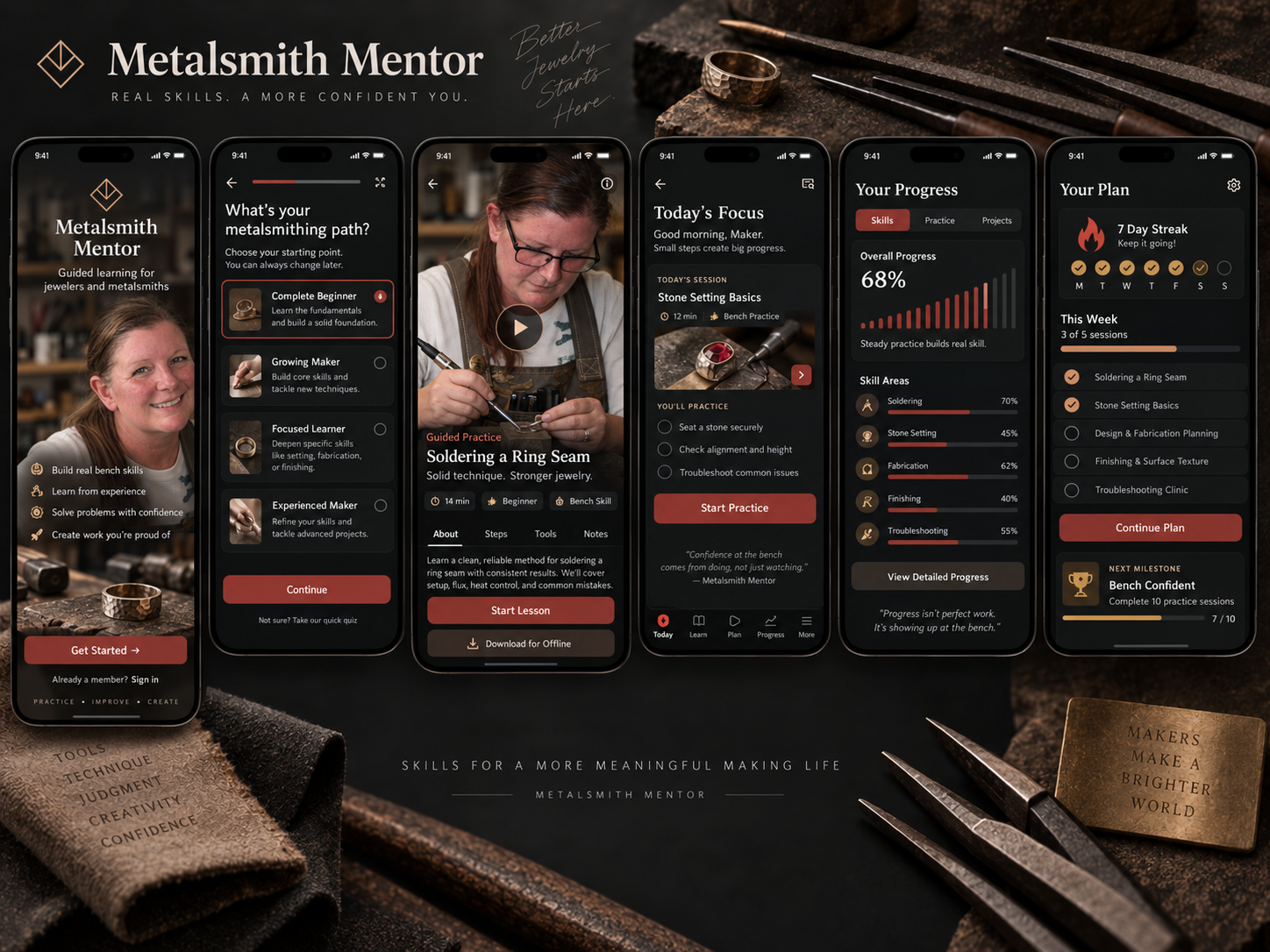
Metalsmith Mentor™
Learn metalsmithing with more confidence, less overwhelm, and a mentor at your bench.
Metalsmithing problems rarely arrive as neat textbook questions.
The solder will not flow.
The bezel keeps collapsing.
The stone still feels loose.
The bur is cutting where you do not want it to.
A technique that worked yesterday suddenly does not work today. And sometimes the hardest question is simply:
What should I do next?
Metalsmith Mentor™ is designed to help jewelers and metalsmiths work through those moments with practical, process-based guidance grounded in how the bench actually works.
Launching October 6, 2026
Join the Waitlist for updates and behind-the-scenes news:
When You Need More Than Another Tutorial
Tutorials are useful when everything goes according to plan. The real learning often begins when it does not.
Metalsmith Mentor™ is built for the space between:
“I watched how to do it.”
and
“I understand why it is not working for me.”
Use the mentor to think through problems involving:
soldering
stone setting
fabrication
forming
measuring
fitting
tools
burs
metal thickness
sequencing
finishing
troubleshooting
skill development
technical decision-making
The goal is not simply to give you another set of steps.
The goal is to help you understand what the metal, the tool, and the process are telling you.
Bring the Bench Problem Into the Conversation
Sometimes one small detail changes the entire answer.
The gauge of the metal.
The size of the stone.
The shape of the setting.
The order of operations.
The tool you are using.
How much heat has already gone into the piece.
Whether the problem began during fabrication or finishing.
Metalsmith Mentor™ helps you work through the specific situation in front of you instead of relying only on generic instructions.
Ask questions such as:
Why will this solder not flow?
Did I use the wrong solder?
Am I heating the correct area?
Is this bezel too thick?
Is my stone seat deep enough?
Why does the stone still move?
Which bur should I use here?
What gauge metal makes sense for this ring?
Should I solder this before or after forming?
Why did this seam open?
Can this piece still be saved?
What should I practice before attempting this technique again?
Those are exactly the kinds of questions the mentor is built to explore.
Troubleshoot the Cause, Not Just the Symptom
A failed solder joint may not really be a solder problem. A loose stone may not actually be a setting problem. A distorted bezel may have begun several steps earlier.
Metalsmithing problems are often cumulative.
Metalsmith Mentor™ is designed to help you think backward through the process:
What happened?
When did it begin?
What variables changed?
What should you check first?
What can still be corrected?
That kind of diagnosis is one of the most important skills a metalsmith can develop. Because once you learn to recognize causes instead of only symptoms, you become far less dependent on memorized fixes.
Soldering Without the Guesswork
Few areas of metalsmithing create more frustration than soldering.
The solder balls up.
It flows to the wrong place.
The seam opens.
The flux burns away.
The piece overheats.
One joint flows while another comes apart.
Metalsmith Mentor™ can help you reason through factors such as:
fit
cleanliness
flux
solder placement
torch control
heat direction
heat balance
solder choice
joint design
sequence
previous solder operations
thermal mass
overheating
Instead of asking only:
“Why didn’t the solder flow?”
you can begin learning to ask:
“What condition prevented it from flowing?”
That is a much more useful question.
Make Better Stone-Setting Decisions
Stone setting is not simply about pushing metal over a stone. Successful setting depends on decisions made long before the final tightening.
Metalsmith Mentor™ can help you think through:
metal thickness
stone dimensions
seat depth
bur selection
bur size
setting order
wall thickness
support
stone security
tool control
finishing
risk to the stone
Whether you are working with bezel setting, flush setting, prongs, or another method, the mentor helps you consider the relationship between the stone, the metal, the tool, and the sequence.
Understand Your Tools Instead of Collecting Them
There is no shortage of tools marketed to jewelers. The more useful skill is knowing why you would choose one tool instead of another.
Metalsmith Mentor™ can help you think through decisions involving:
burs
files
saw blades
torch tips
pliers
hammers
abrasives
measuring tools
flex-shaft accessories
setting tools
forming tools
finishing tools
Ask not just:
“What tool do I need?”
but:
“What job am I asking the tool to do?”
That distinction can save money, reduce frustration, and improve control at the bench.
Learn the Sequence, Not Just the Step
In metalsmithing, the order of operations matters.
A perfectly executed step can still create trouble if it happens at the wrong time.
Metalsmith Mentor™ can help you think through questions such as:
What should be soldered first?
What should be shaped before soldering?
What should wait until after setting?
When should a surface be finished?
Should this element be fabricated separately?
When will access to this area become difficult?
Which operation creates the most risk later?
Learning to plan the sequence is one of the ways a metalsmith moves from simply following instructions to working more independently.
Know When to Stop and Reassess
Sometimes the best move at the bench is not another cut, another solder attempt, or another push of the metal. It is to stop.
Metalsmith Mentor™ can help you identify when it makes sense to:
inspect the fit
remeasure
anneal
clean
change tools
change technique
rework a component
remake a component
practice the step separately
abandon a risky repair
reconsider the sequence
That pause can prevent a small problem from becoming an expensive one.
Build Skills in the Right Order
Another difficult question for developing metalsmiths is:
What should I learn next?
It is easy to jump from technique to technique without building the underlying skills that make advanced work easier.
Metalsmith Mentor™ can help you think through skill progression based on what you already know and what you want to make.
That may include:
sawing
filing
fitting
soldering
forming
measuring
surface control
stone setting
finishing
tool control
sequencing
troubleshooting
The goal is not to collect techniques.
It is to build a bench practice where one skill supports the next.
Use Practice as Information
Practice is not simply repetition. Useful practice tells you something.
What happened when you changed the flame?
What happened when you reduced the gap?
What happened when you changed the bur?
What happened when you used thicker metal?
What changed when you slowed down?
Metalsmith Mentor™ is designed to help you reflect on practice so repetition becomes learning rather than simply more attempts.
Designed for the Moment You Get Stuck
Metalsmith Mentor™ may be especially useful if you:
understand basic metalsmithing but still encounter inconsistent results
want to become better at diagnosing problems
are moving from beginner techniques into intermediate work
frequently wonder whether you are using the right tool
struggle with soldering
are learning stone setting
want more confidence choosing metal thicknesses and dimensions
find yourself searching multiple sources for one answer
want to understand why a technique works
want help deciding what to practice next
are trying to become more independent at the bench
You do not need to know the correct terminology before asking the question.
Start with what you see happening.
Mentoring, Not Just Answers
A quick answer may solve today’s problem.
Understanding the decision behind the answer helps solve tomorrow’s problem too.
Metalsmith Mentor™ is built around that distinction.
The mentor can help you:
identify likely causes
compare possible solutions
understand tradeoffs
consider risk
choose the next step
evaluate the result
decide what to practice
recognize patterns across your work
Over time, the aim is not simply to help you ask better questions.
It is to help you need fewer answers because your own judgment has become stronger.
Know Which Mentor You Need
The three Metalsmith Mentor™ apps are intentionally separated because fabrication, design, and business require different kinds of thinking.
Metalsmith Mentor™
For:
Fabrication
Soldering
Stone setting
Troubleshooting
Tools
Bench technique
Process
Skill development
Metalsmith Design Mentor™
For:
Design critique
Sketch development
Composition
Proportion
Series development
Creative direction
Design journaling
Personal design language
Metalsmith Business Mentor™
For:
Pricing
Profitability
Marketing
Products
Customers
Positioning
Planning
Sustainable growth
If the question is happening at the bench, Metalsmith Mentor™ is where to start.
Better Judgment Is the Real Skill
Techniques matter.
Tools matter.
Practice matters.
But one of the most valuable skills you can develop is knowing how to evaluate what is happening in front of you.
Why did that joint fail?
Why is that stone moving?
Why did the metal distort?
Why did this tool behave differently?
What should happen next?
Those questions are the beginning of independence at the bench.
Metalsmith Mentor™ is built to help you develop that independence.
Bring the Problem. Build the Skill.
The next time something does not work, you do not have to treat it as a failure.
It can become information.
A clue.
A question.
A chance to understand the process more deeply.
Bring the bench problem into the conversation.
Metalsmith Mentor™ launches October 6, 2026.
Join the Metalsmith Mentor™ Waitlist for updates and behind-the-scenes news:
Better bench decisions. Stronger skills. Less guesswork.