

The Makers Who Shaped Me: Betty Helen Longhi: Learning to Make Metal Feel Alive
Some artists influence the techniques we use.
Others change the way we see the material itself.
Betty Helen Longhi did both for me.
I was fortunate enough to eventually meet Betty at a SNAG conference, which remains one of those wonderful moments in my metalsmithing journey when someone I had known through their work suddenly became a real person standing in front of me.
But Betty's influence on me began long before that conversation.
It began with a simple idea that became incredibly important to my own work:
Metal doesn't have to look like metal.
It can swell.
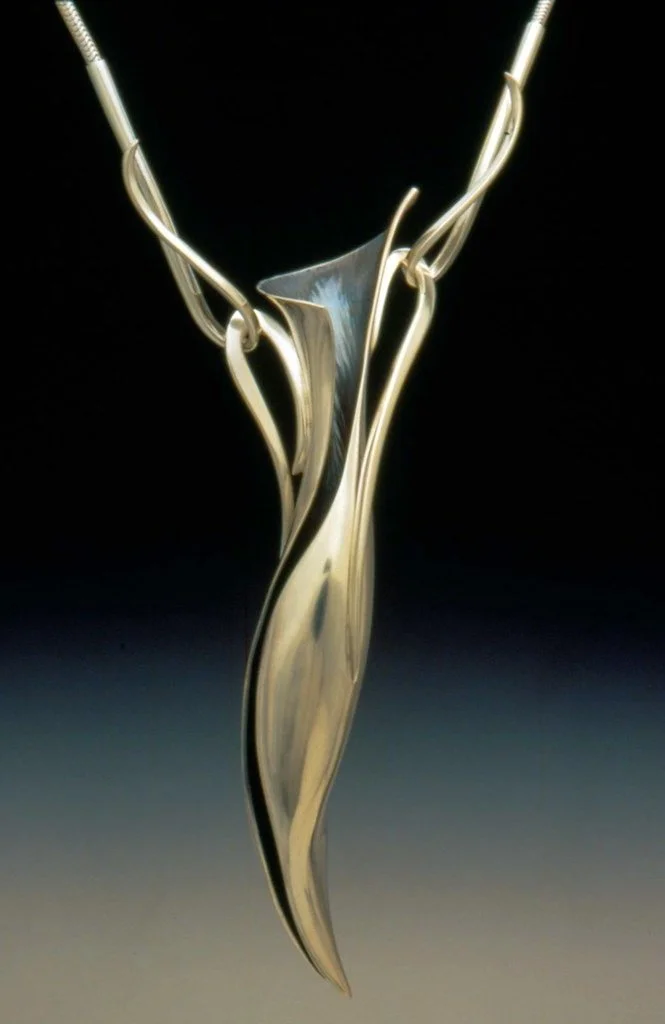
It can curve.
It can twist.
It can appear soft, fluid, botanical, anatomical—even alive.
And once I understood that, an entirely different world opened at my bench.
From Flat Sheet to Living Form
Betty Helen Longhi was a nationally recognized metalsmith whose career centered heavily on forming metal for jewelry and sculpture. She studied at the University of Wisconsin and Cranbrook Academy of Art and studied with the extraordinary Finnish-American metalsmith Heikki Seppä, whose development of shell structures and new approaches to forming profoundly influenced contemporary metalsmithing. Betty later became an important teacher of those processes herself.
But what fascinates me about Betty's work isn't simply the technique.
It's what she did with it.
Her forms have movement.
They feel organic rather than constructed.
You can look at one of her pieces and understand intellectually that it began as sheet metal, but visually your brain tells you something entirely different.
A leaf.
A pod.
A shell.
A blossom.
Something caught in the process of opening.
That fascinated me.
Because I was becoming increasingly interested in many of those same questions in my own work.
How Do You Make Something Hard Feel Soft?
That became an important question for me.
Metal is stubborn.
It's hard.
It's industrial.
It arrives at the bench as flat sheets, straight wire, tubing and stock.
But the things I wanted to explore weren't industrial at all.
I was interested in the body.
Anatomy.
Protection.
Vulnerability.
Organic structures.
Forms that felt as though they might have grown rather than been fabricated.
Betty's work helped me understand that those ideas weren't at odds with metalsmithing.
The contradiction was actually part of what made them interesting.
You could take a material we associate with permanence and strength and manipulate it until it suggested softness, movement and life.
Suddenly, the limitations of metal became part of the conversation.
Following the Metal Instead of Fighting It
Betty once described forming and forging as her preferred ways of working because they allowed her to create the fluid lines she wanted. She also spoke about the satisfaction of producing graceful forms from something as unyielding as flat sheet or straight wire.
I understand exactly what she meant.
There's a point during forming when you stop feeling as though you're imposing a shape onto the metal.
You start responding to it.
One hammer blow changes the possibilities for the next.
A curve begins to develop.
Volume appears where there was none.
The metal begins telling you where it wants to go.
That relationship between maker and material became increasingly important in my own work.
Rather than asking only, How do I fabricate this shape?
I started asking:
How can I encourage the metal to become this form?
That's a very different way of working.
And it changed my work.
Finding My Own Organic Language
One of the things I appreciate most about Betty's story is something Heikki Seppä himself said about her.
He recognized his technical influence in her work, but he was equally clear that her style and approach belonged to Betty.
That's exactly what good teaching should accomplish.
The goal isn't replication.
It's vocabulary.
A teacher gives you another way to move metal, another way to understand form, another tool for solving a problem—and eventually you stop thinking about where you learned it.
It becomes part of your own language.
That's what happened for me.
I wasn't interested in making Betty Helen Longhi's forms.
I wanted to understand what her forms taught me was possible.
And from there, I could explore my own ideas.
When Organic Form Became Meaning
Eventually, organic form became much more than a visual preference in my work.
It became part of the content.
My graduate work explored the human body, vulnerability, protection and the complicated relationship between what we reveal and what we protect.
That meant the metal couldn't simply represent anatomy.
It needed to feel anatomical.
Surfaces needed tension.
Forms needed volume.
Edges needed to curl, stretch or emerge.
Metal needed to suggest tissue, organs and structures that seemed to exist somewhere between something fabricated and something grown.
When I look back at that work now, I can see how artists like Betty helped give me permission to pursue those forms.
Not by showing me what to make.
By showing me what metal could become.
And Then I Got to Meet Her
Years later, I had the opportunity to meet Betty at a SNAG conference.
There is something wonderfully surreal about meeting someone whose work has already occupied space in your creative life.
You know their work.
You've studied their techniques.
You've absorbed ideas from them without ever having a conversation.
And then suddenly you're standing together talking about metal.
Those encounters at SNAG became some of my most treasured memories from that period of my career.
Betty wasn't simply a name attached to a technique or a book anymore.
She was another metalsmith.
Another person fascinated by what happens when hammer meets metal and an idea begins taking shape.
I'm very grateful I had the opportunity to meet her.
Betty passed away in June 2025 after a remarkable career as an artist, teacher and mentor. Her influence continues through her work, her students and the knowledge she helped preserve for future metalsmiths.
Teaching Process, Not Product
There's another part of Betty's philosophy that resonates even more strongly with me today.
She described her goal as a teacher as teaching process, not product. She wanted students to understand the possibilities well enough that their experimentation could take the technique somewhere she hadn't necessarily anticipated herself.
I love that.
Because that's exactly the kind of metalsmith I want to help develop.
I can teach someone how I would make a bezel.
I can demonstrate how I would solve a fabrication problem.
I can explain why I choose one tool instead of another.
But ultimately, I don't want students to make jewelry like mine.
I want them to understand metal well enough to make the work that exists in their imagination.
Betty Helen Longhi helped do that for me.
She showed me that a flat sheet of metal wasn't really flat at all.
It was simply a form that hadn't happened yet.
And sometimes, with enough curiosity, patience and a hammer, you can convince that hard sheet of metal to become something that almost feels alive.