

Opal is one of those gemstones that can make a jeweler forget about everything except color.
Red appears. Then green. Then blue. Move the stone slightly and the entire pattern changes.
But at the bench, fascination has to be followed by: “What exactly am I working with?” Opal behaves very differently from many faceted gemstones.
Opal Is Not a Typical Crystalline Gem
Opal is hydrated amorphous silica, commonly represented as SiO₂·nH₂O. Unlike sapphire, quartz, or garnet, opal lacks the same orderly crystalline structure.
GIA notes that opal can contain as much as about 20% water within its structure and ranges from approximately 5 to 6.5 on the Mohs hardness scale.
It is comparatively easy to scratch and needs care around heat and sudden temperature change. GIA rates its toughness from very poor to fair and notes that excessive heat or abrupt temperature changes can cause fracture or crazing.
Hardness measures resistance to scratching; it does not tell us how a stone survives impact, concentrated setting pressure, heat, or a slipped tool.
Why Precious Opal Shows Play-of-Color
In precious opal, tiny silica spheres can form sufficiently ordered structures to interact with light, producing play-of-color. Change the viewing angle and the colors change.
But beauty is not durability. A spectacular stone can have thin edges, existing surface crazing, fragile areas, or a shape that creates difficult pressure points. Inspect it before designing the setting.
Setting Pressure Is a Major Consideration
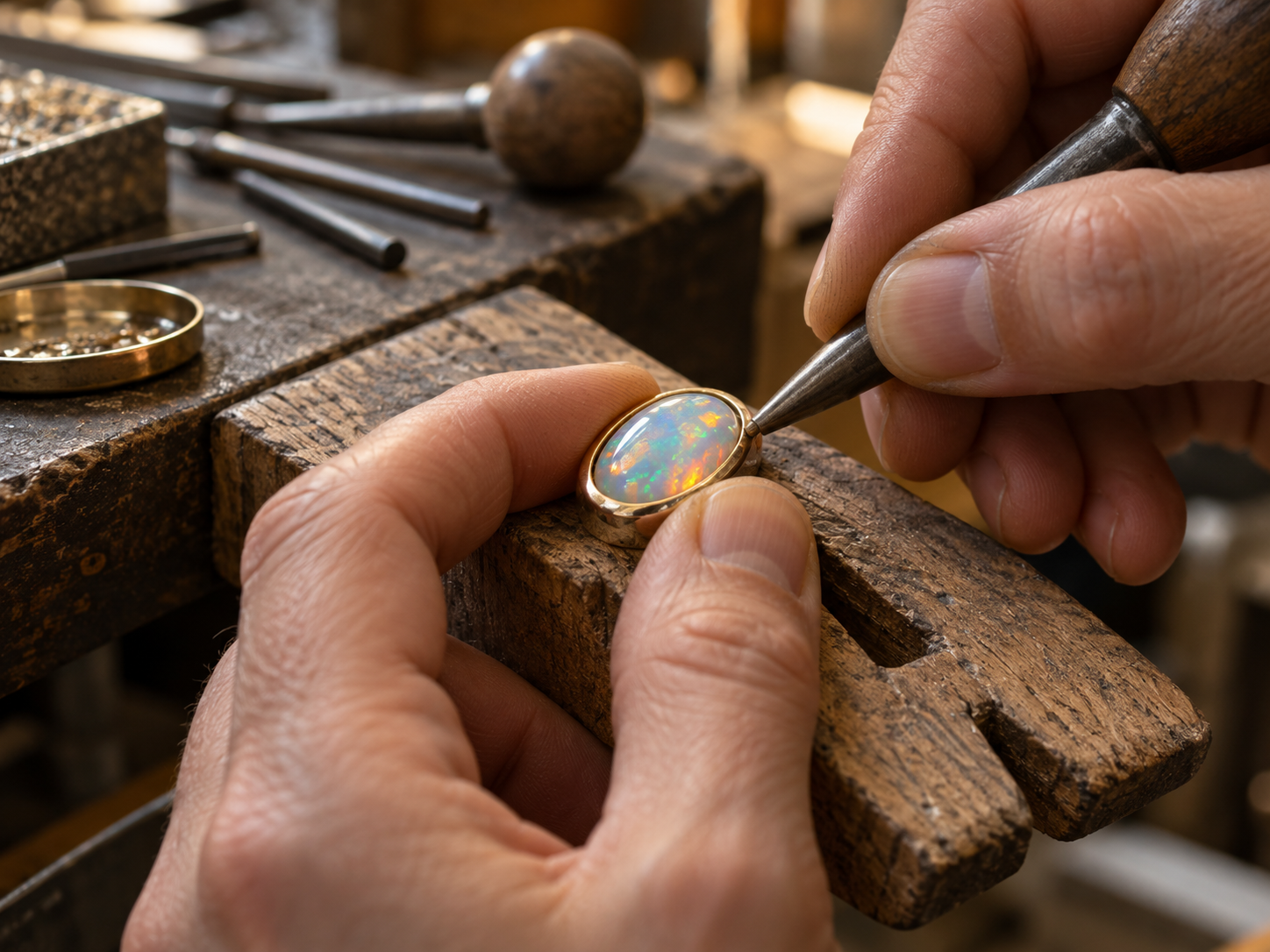
Think about distributing force rather than concentrating it. A protective bezel may work well because it supports the perimeter, but only when fitted properly.
If one small section contacts the stone before everything else, that area receives concentrated pressure as the metal moves. The same applies to prongs.
The important question is not simply “Can I move this prong over the stone?” but “Where is the force going while I move it?”
Finish More Before You Set
Complete soldering before the opal is installed whenever possible. Prepare and finish hard-to-reach surfaces, polish areas you cannot safely reach later, and make sure the seat fits before permanent installation.
The less aggressive work left around the set opal, the fewer opportunities for damage.
Heat Is Not Something to Gamble With
Do not approach repair of opal-set jewelry as though the stone were ruby or diamond. Intense heat and sudden temperature changes may cause crazing or fracture.
Identify the stone and construction before deciding whether a repair can be done with the stone in place. Not every opal is a single solid stone.
Solid Opal, Doublet, or Triplet?
A doublet generally joins a layer of opal to a backing. A triplet adds a transparent protective cap above a thin opal layer and backing.
They can look convincing from above, but adhesives and multiple materials create added sensitivity to heat, solvents, moisture, and cleaning. Never assume the construction from the face-up appearance alone.
Cleaning Requires Restraint Too
GIA recommends warm, soapy water as the safe cleaning method. Opals can also be treated with oil, wax, plastic, or other substances, which may affect care.
Avoid ultrasonic cleaning: vibration, temperature, existing fractures, assembly, and treatments create unnecessary risks.
Before You Work on an Opal
Look carefully at its edges; check for cracks or crazing; determine if it is solid or assembled; ask about known treatments; consider exposure in the design; identify pressure points; and plan heat-producing fabrication before the stone comes near the piece.
These are not signs that opal is a bad jewelry stone. They are signs that opal needs to be treated like opal.
The Gemstone Should Influence the Jewelry
We should not design a setting in isolation and then expect every gemstone to tolerate it. Material, structure, cut, condition, treatment, and intended wear all matter.
Opal rewards careful planning with color that seems to move inside the stone. Our job is to protect what makes it extraordinary.
Do you work with opal often? If you have a question about setting, identifying, cleaning, or designing around one, leave it in the comments below. If there is enough interest, I’ll turn the most common questions into a dedicated Opal Bench Reference for My Bench.